

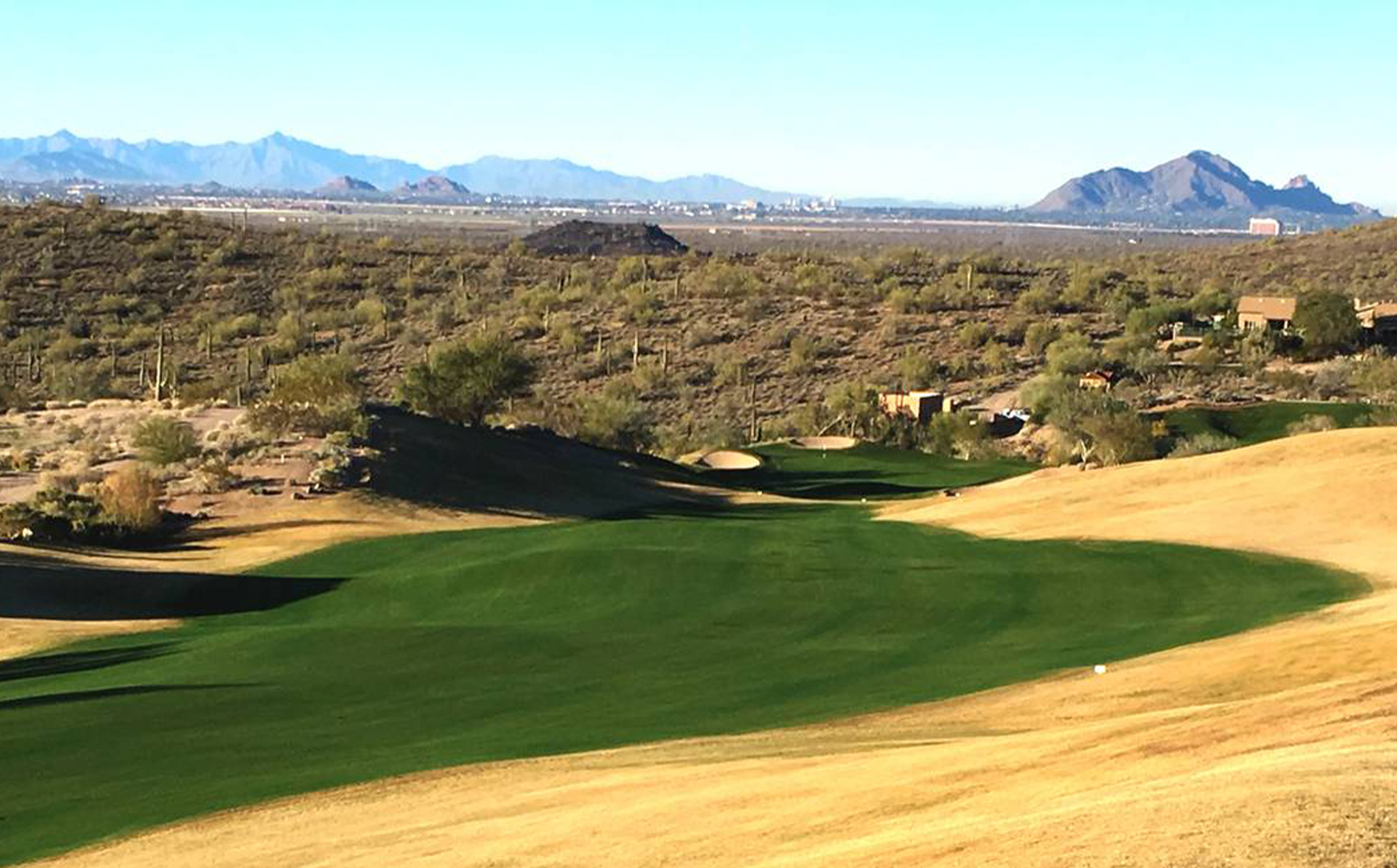
Arizona’s overseed season is just around the corner, and as courses prepare for cool-season grass, many facilities will temporarily close.
To keep up with course closures and reopening dates throughout the state, golfers can visit azgolf.org/overseed for a continuously updated overseed schedule.
Once courses begin welcoming golfers back, there are a few things players should be prepared for. AZ GOLF Head of Rules & Competitions, Logan Rasmussen, shared some tips to help golfers get ready.
Cart Path Only
Right after overseed, golfers can expect many courses to operate under cart path only conditions.
“Ready golf is important when it’s cart path only,” Rasmussen explained. “Rounds are naturally going to take a little longer because of that extra walking, but ready golf will help speed it up.”
One way to keep things moving is to be prepared before walking to your ball. From the cart path, use your range finder to get an idea of your distance. Then, take the club you would normally hit from that yardage, along with one club up and one club down, to your ball.
Once you reach your ball, use your range finder for one final distance and select the appropriate club. This can eliminate unnecessary trips back and forth between your ball and the cart.
Golfers sharing a cart can also work together to save time. If the two players’ balls are at different distances, the player with the shorter shot should play first. While that golfer walks toward their ball, the other player can drive toward their ball and begin determining their yardage from the path. That way, both players can be ready to hit without waiting on one another.
Expect Softer Playing Conditions
With courses going through the overseed process and establishing the new playing surface, golfers may encounter softer conditions which can have a noticeable impact on how far the ball travels.
Rasmussen’s pro tip: A wetter golf course plays longer.
Golf balls won’t roll out as much on softer ground, while the growing grass can also slow the ball down. Golfers may want to consider taking more club than they normally would during Arizona’s summer months.
It may also be worth considering a shorter set of tees to account for the change in playing conditions.
Keep an Eye on Your Handicap
The conditions following overseed can also affect how scores are treated for Handicap Index purposes.
Because courses can play slightly more difficult under soft conditions than normal, golfers should be prepared for potential Playing Conditions Calculation (PCC) adjustments early in the overseed season.
PCC is designed to account for abnormal playing conditions when determining how scores should be used for handicap purposes. So don’t be surprised if your score receives an adjustment on a day when the course is playing particularly differently from its normal conditions.
Embedded Ball
Softer conditions can also create situations where a golf ball becomes embedded.
Under the Rules of Golf, a ball is embedded when it is in its own pitch-mark made by the previous stroke in the general area, except in naturally sandy areas.
The general area includes the fairway, rough and collar of the green. That’s an important distinction in Arizona, where many courses have natural sandy or desert areas. Even though those areas may technically be part of the general area, embedded-ball relief does not apply in naturally sandy areas.
The rules also changed in 2019. Previously, embedded-ball relief generally applied only to closely mown areas, but the current rules allow relief for an embedded ball in the rough as well because it is now considered general area.
Golfers who are unsure whether their ball is actually embedded, particularly in thick rough, can mark the ball and pick it up without cleaning it to determine whether it broke the surface of the soil. If it did, relief is available. If not, simply place the ball back in its original position for no penalty.
Once you’re entitled to embedded-ball relief, you may clean your ball or substitute another ball.
To take relief, find the nearest point of complete relief from the embedded ball. This will typically be directly behind the spot where the ball was embedded. From there, drop a ball within one club-length of that spot, no closer to the hole.
Temporary Water
Temporary water is another condition golfers may encounter during the transition following overseed.
Formerly referred to as “casual water,” temporary water is any temporary accumulation of water on the surface of the ground that is not in a penalty area.
If temporary water interferes with your lie, stance or area of intended swing, you may be entitled to free relief.
There’s an important test to remember: the water must be visible before or after you take your normal stance. You don’t need to stomp your feet into the ground to make water appear.
As Rasmussen puts it, “It’s the stance, not the dance.”
The relief procedure is similar to that for an embedded ball. Determine the nearest point of complete relief and drop a ball within one club-length of that spot, no closer to the hole.
Overseed season is a significant annual transition for Arizona golf courses, and golfers may notice differences in course conditions and pace of play when courses reopen.
A little preparation can go a long way. Be ready for cart path only restrictions, give yourself extra time for walking, adjust your club selection for softer conditions and know the Rules of Golf situations you may encounter.
For the latest information on course closures and reopening dates throughout Arizona, visit AZ GOLF’s Overseed Schedule before your next round.